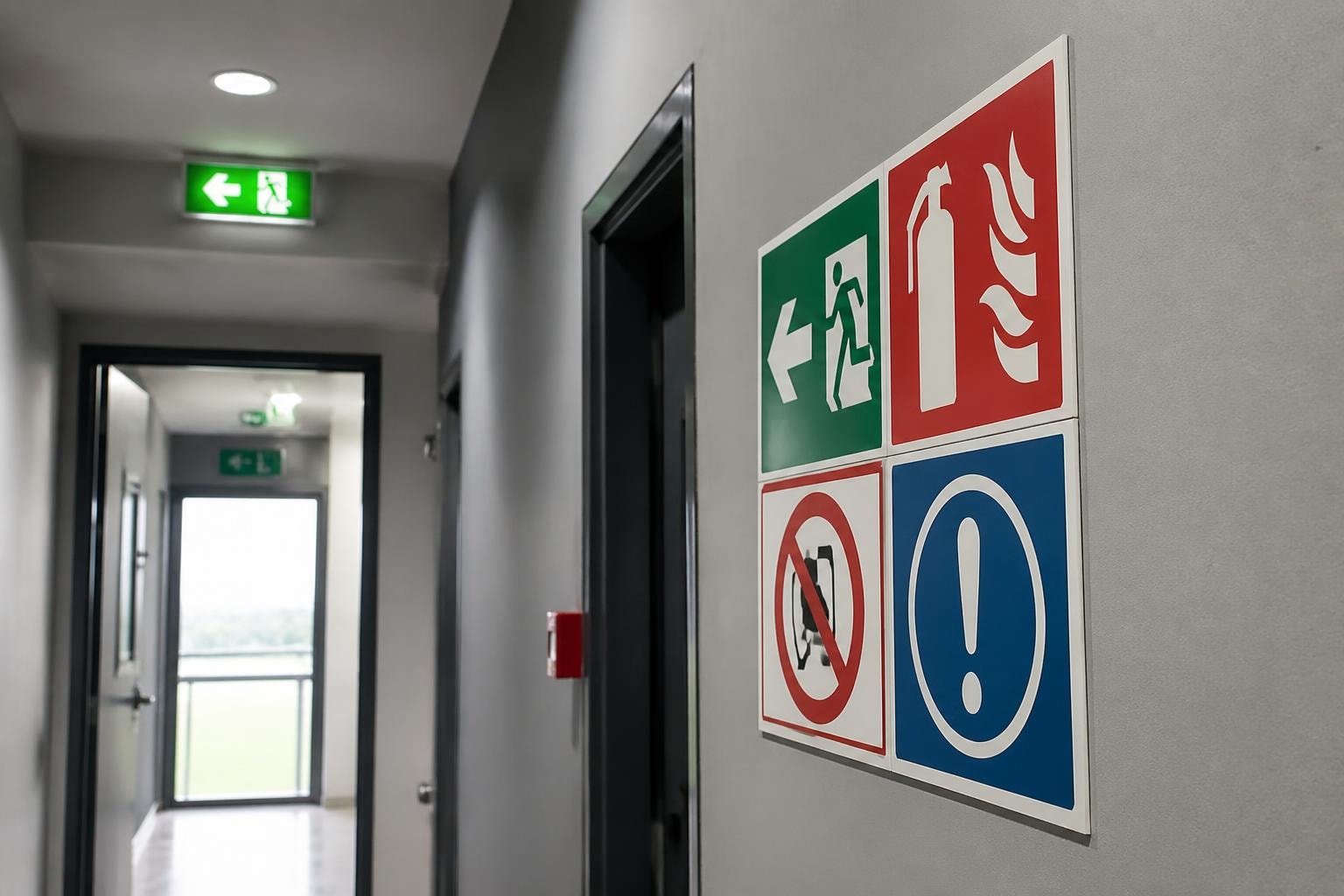
Fire and safety signs serve as the first line of defence in protecting building occupants during emergencies. These visual communication tools guide people to safety, identify hazards, indicate the location of firefighting equipment, and enforce critical safety procedures. In commercial premises across the United Kingdom, properly installed and maintained signage is not merely recommended practice but a legal requirement under the Regulatory Reform (Fire Safety) Order 2005. For business owners and Responsible Persons, understanding the nuances of fire and safety signs ensures compliance whilst creating a safer environment for employees, visitors, and contractors.
Understanding the Legal Framework for Fire and Safety Signs
The Regulatory Reform (Fire Safety) Order 2005 places clear duties on those responsible for premises to ensure appropriate fire safety measures are in place. This legislation mandates that fire and safety signs must be displayed wherever necessary to facilitate safe evacuation and identify fire safety equipment.
Beyond this primary legislation, the Health and Safety (Safety Signs and Signals) Regulations 1996 implement EU directive requirements, establishing minimum standards for safety signage across workplaces. These regulations specify design criteria, colour conventions, and placement protocols that must be followed.
Key regulatory requirements include:
- Clear marking of all emergency exits and escape routes
- Identification of fire alarm call points
- Signposting of firefighting equipment locations
- Warning signs for hazardous areas or materials
- Mandatory action signs where personal protective equipment is required
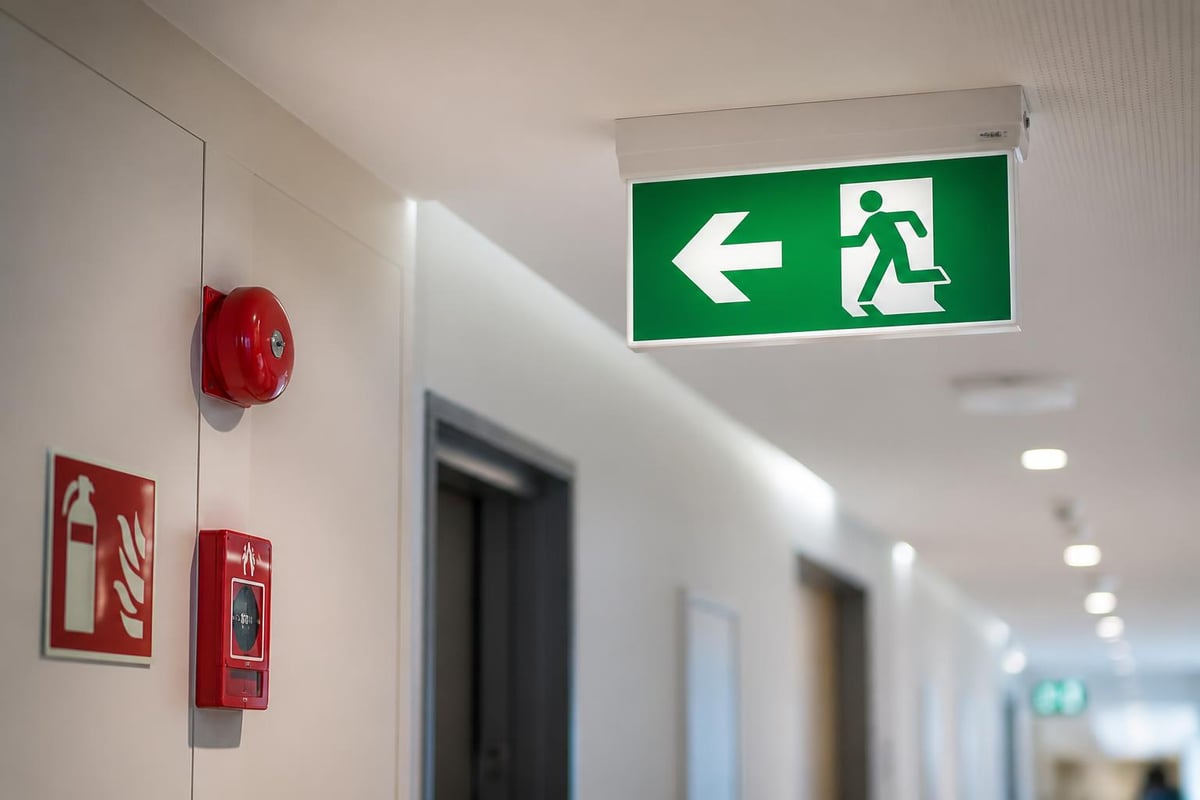
The fire safety sign regulations establish that signage must be visible, legible, and understood by all building users regardless of their first language. This international standardisation ensures that pictograms convey meaning without relying solely on text.
Categories of Fire and Safety Signs
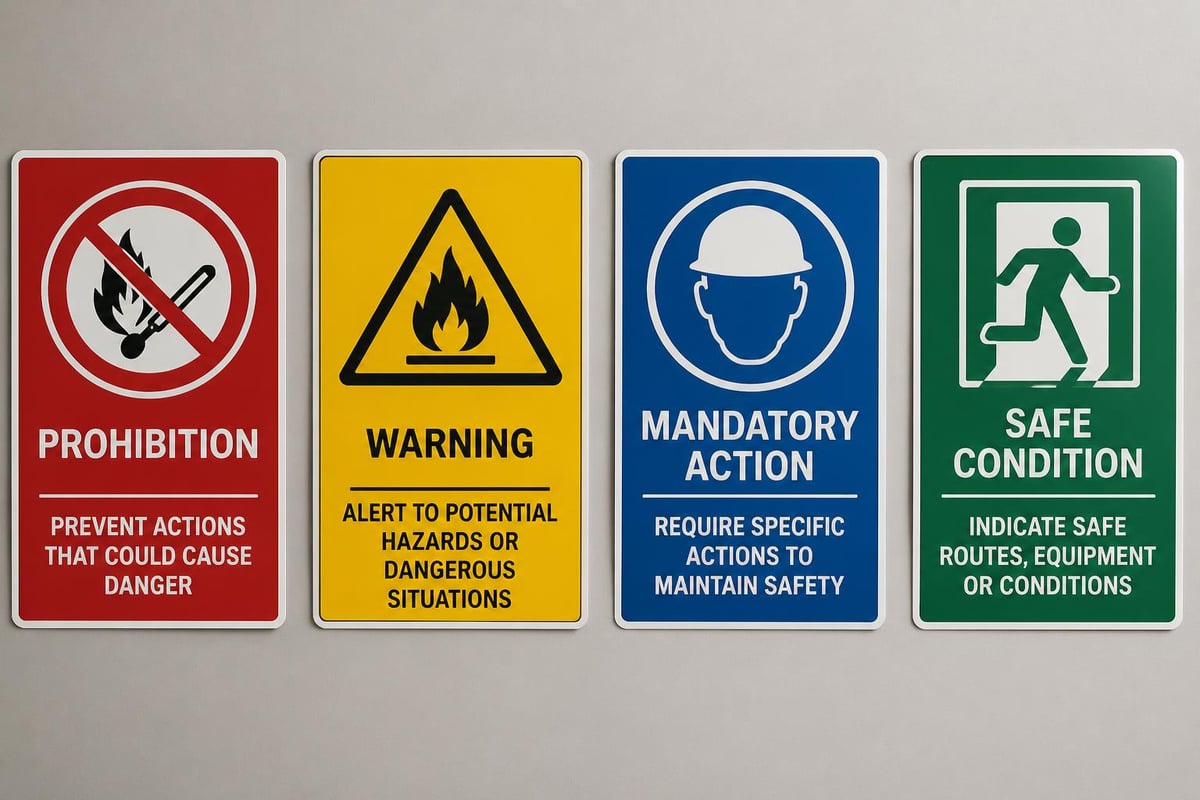
Fire and safety signs fall into distinct categories, each serving specific communication purposes within a building's safety strategy. Understanding these classifications helps Responsible Persons select and position signage effectively.
Prohibition Signs
Prohibition signs communicate actions that must not be taken. These circular signs feature a red border with a diagonal line crossing a black pictogram on a white background.
Common prohibition signs include:
- No smoking symbols in areas with flammable materials
- No naked flames warnings near oxygen or combustible storage
- Do not use lift in event of fire notices at lift entrances
- No entry signs restricting access to hazardous zones
Warning Signs
Warning signs alert people to potential hazards that require caution. These triangular signs display a yellow background with black borders and pictograms.
Examples include:
- Flammable material warnings
- Electrical hazard notifications
- High temperature surface alerts
- Explosive atmosphere cautions
Mandatory Action Signs
Mandatory action signs indicate actions that must be carried out. Circular blue signs with white pictograms specify required behaviours.
Typical mandatory signs specify:
- Fire door keep shut instructions
- Fire door keep locked instructions (when appropriate)
- Personal protective equipment requirements
Safe Condition Signs
Safe condition signs provide crucial information about emergency facilities and evacuation routes. These rectangular green signs with white pictograms or text are perhaps the most recognisable fire and safety signs.
| Sign Type |
Purpose |
Standard Locations |
| Fire exit |
Marks escape route exits |
All final exit points |
| Running man directional |
Indicates escape route direction |
Along corridors, at decision points |
| Assembly point |
Shows muster location |
External areas, car parks |
| First aid |
Identifies medical facilities |
Throughout premises |
Fire Equipment Signs
Fire equipment signs identify the location of firefighting apparatus. These rectangular red signs with white text or pictograms ensure rapid equipment access during incidents.
Standard fire equipment signs mark:
- Fire extinguisher positions
- Fire hose reel locations
- Fire alarm call point positions
- Fire blanket storage
- Dry riser and sprinkler control valve positions
The OSHA specifications provide additional context on design standards, though UK regulations follow BS EN ISO 7010 as the primary standard.
Strategic Placement and Visibility Requirements
The effectiveness of fire and safety signs depends entirely on their strategic positioning throughout a building. Poor placement renders even the highest quality signage ineffective during emergencies when stress levels are elevated and visibility may be compromised by smoke or power failure.
Exit Route Signage
Emergency exit signs must create an unambiguous path from any point within the building to a place of ultimate safety. This requires careful consideration of sightlines, decision points, and potential confusion areas.
Best practice placement includes:
- Signs positioned above final exit doors at a height of approximately 2-2.5 metres
- Directional signs at every point where route choice exists
- Additional low-level wayfinding in premises where smoke drop is anticipated
- Illuminated or photoluminescent signs in areas without adequate emergency lighting
When planning fire door installation as part of passive fire protection measures, appropriate signage must be integrated from the outset to ensure doors remain closed or, where appropriate, remain locked with appropriate emergency egress hardware.
Fire Equipment Identification
Firefighting equipment must be immediately identifiable to any building occupant. The regulations governing fire safety signs specify that equipment location signs should be placed directly above or adjacent to the equipment itself.
For wall-mounted fire extinguishers, signs should be positioned:
- Directly above the extinguisher at consistent height throughout the building
- At a minimum height of 2 metres from floor level
- With supplementary floor markings in large open areas
- With directional indicators where equipment is recessed or around corners
Fire alarm call points require clear identification with signage positioned immediately above each device. In modern buildings, fire alarm systems integrate with building management systems, but visual signage remains critical for manual activation during emergencies.
Design Standards and Material Specifications
Modern fire and safety signs must conform to British Standard BS EN ISO 7010, which superseded older BS 5499 designs. This international standard ensures consistency across borders whilst maintaining the distinctive colour coding system recognised throughout the UK.
Size and Proportions
Sign size must correlate with viewing distance. The Health and Safety Executive provides guidance on minimum sign dimensions based on the maximum distance from which the sign must be legible.
| Viewing Distance |
Minimum Sign Height |
Typical Applications |
| Up to 10 metres |
150mm |
Small rooms, corridors |
| 10-20 metres |
200mm |
Medium spaces, retail areas |
| 20-30 metres |
300mm |
Large warehouses, factories |
| Over 30 metres |
Custom calculation |
Industrial halls, atriums |
Material Durability
Fire and safety signs must withstand environmental conditions whilst maintaining legibility throughout their service life. Material selection should account for:
- Rigid plastic: Suitable for internal environments with moderate wear
- Self-adhesive vinyl: Appropriate for smooth surfaces in low-traffic areas
- Aluminium composite: Ideal for external applications and high-wear locations
- Photoluminescent material: Required where emergency lighting may fail
Photoluminescent signs absorb ambient light and glow in darkness, providing continued visibility during power failures. These signs are increasingly specified in modern buildings as they eliminate reliance on electrical power for emergency wayfinding.
Maintenance and Inspection Protocols
Fire and safety signs deteriorate over time through exposure to light, temperature fluctuations, physical contact, and general wear. Regular inspection and maintenance ensure signage remains effective when needed most.
Inspection Frequency
Monthly checks should verify:
- Signs remain securely affixed to mounting surfaces
- No physical damage, fading, or discolouration
- Text and pictograms remain clearly legible
- Illuminated signs function correctly
- Photoluminescent signs charge adequately from ambient light
Annual comprehensive reviews should assess:
- Whether signage remains appropriate following building alterations
- Compliance with current standards and regulations
- Consistency of sign types and designs throughout premises
- Adequacy of coverage for all escape routes and equipment
These inspections should form part of broader fire safety audits. When conducting fire risk assessments, qualified assessors evaluate signage adequacy alongside other fire safety measures.
Replacement Criteria
Fire and safety signs should be replaced when:
- Fading reduces colour contrast below recognisable levels
- Physical damage compromises pictogram clarity
- Adhesive failure causes signs to detach partially or completely
- Regulatory changes introduce new standard designs
- Building modifications render existing signage obsolete or misleading
The guidance on fire safety signages emphasises that worn or damaged signage creates liability concerns and may invalidate insurance policies following incidents.
Integration with Emergency Lighting Systems
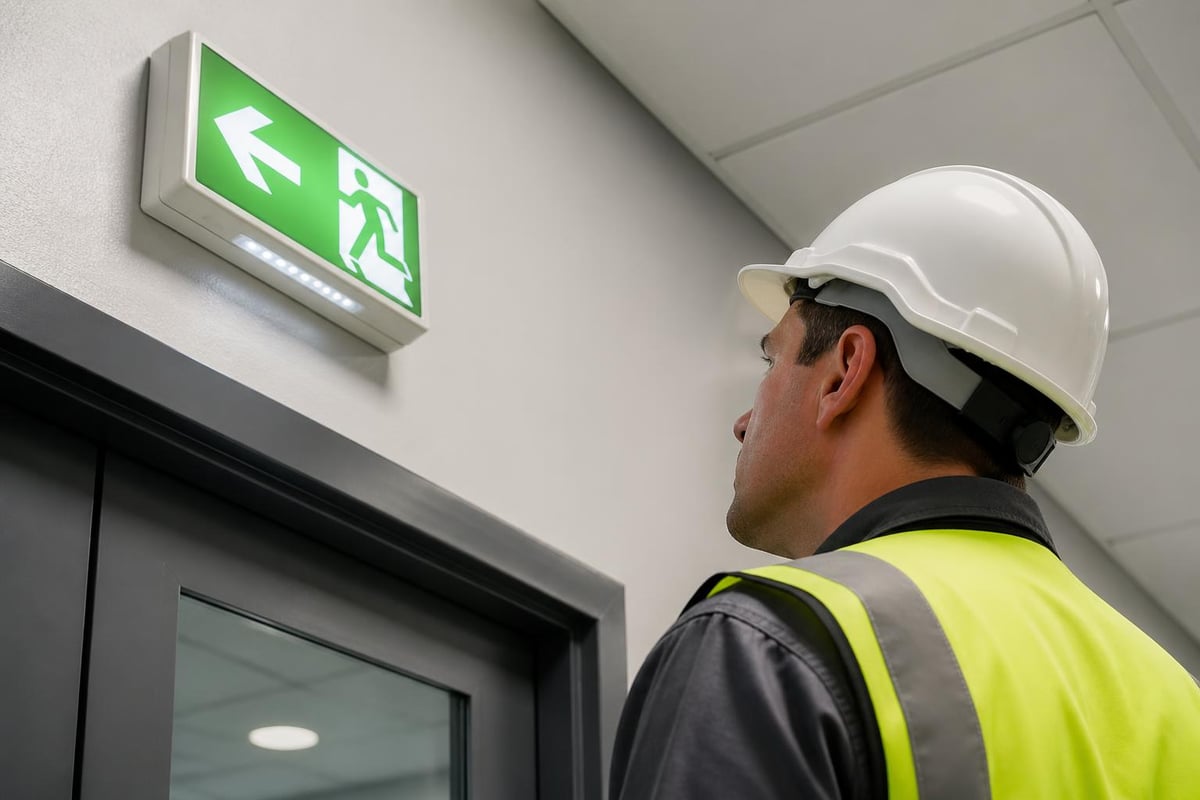
Fire and safety signs work in conjunction with emergency lighting to ensure continuous visibility during power failures. The relationship between these two safety systems requires coordinated planning and installation.
Illuminated Sign Options
Internally illuminated signs contain:
- LED light sources with battery backup
- Self-testing functionality with status indicators
- Minimum 3-hour emergency duration
- Automatic switching on mains failure
Externally illuminated signs rely on:
- Dedicated emergency spotlights positioned to eliminate shadows
- Strategic placement of emergency luminaires along escape routes
- Coordination between lighting designers and fire safety consultants
Non-Electrical Alternatives
Photoluminescent materials offer reliable performance without electrical infrastructure. These signs absorb light energy during normal conditions and release it gradually in darkness, maintaining visibility for several hours.
Advantages include:
- No electrical installation or running costs
- Elimination of battery maintenance requirements
- Compliance with sustainability objectives
- Reliability during extended power outages
Common Compliance Failures and How to Avoid Them
Despite clear regulatory guidance, fire and safety signs frequently fail to meet required standards during enforcement inspections. Understanding common deficiencies helps Responsible Persons maintain compliance.
Inconsistent Signage Designs
Buildings often accumulate different sign styles over years of piecemeal replacement. Mixing BS 5499 and BS EN ISO 7010 designs creates confusion, particularly regarding directional arrows and pictogram designs.
Solution: Conduct a comprehensive sign audit and implement a planned replacement programme to achieve consistency with current BS EN ISO 7010 standards.
Inadequate Coverage of Escape Routes
Complex buildings may have blind spots where occupants cannot see the next exit sign from their current position. This contravenes the principle of continuous wayfinding.
Solution: Walk through all possible evacuation routes at night with normal lighting extinguished to identify visibility gaps and install additional directional signage as required.
Obstructed or Obscured Signs
Furniture, displays, equipment, or accumulated storage frequently obscure fire and safety signs, rendering them invisible when needed.
Solution: Implement clear space policies around all safety signage and include obstruction checks in monthly housekeeping inspections.
Missing Fire Door Signage
Fire doors require appropriate identification to ensure they remain closed (or locked with appropriate escape mechanisms). The importance of fire door inspection extends to verifying correct signage installation.
The effectiveness of fire extinguisher signs demonstrates how proper equipment identification significantly reduces response times during incidents.
Specialised Signage for Specific Premises Types
Different building types present unique challenges requiring tailored fire and safety signs approaches beyond standard provisions.
Healthcare Facilities
Hospitals and care homes serve vulnerable populations with mobility limitations and cognitive impairments. Enhanced signage strategies include:
- Larger signs with simplified pictograms
- Tactile elements for visually impaired occupants
- Colour-coded zone identification integrated with wayfinding
- Multilingual text additions in diverse communities
Industrial and Warehouse Environments
Large-scale industrial premises require signage visible from significant distances across open areas. Additional considerations include:
- Oversized signs scaled to viewing distances exceeding 30 metres
- Suspended signs visible above racking and machinery
- Hazard-specific warnings for processes involving flammable materials
- Floor marking systems complementing wall-mounted signage
Heritage and Listed Buildings
Conservation requirements may restrict signage options in historically significant properties. Acceptable solutions include:
- Discreet fixings that minimise building fabric damage
- Reversible installation methods
- Period-appropriate materials and finishes where permitted
- Enhanced training to compensate for reduced signage visibility
Multi-Tenancy Commercial Buildings
Office buildings with multiple occupiers require coordinated signage strategies addressing shared and demised areas. Landlords must ensure:
- Consistent signage design throughout common parts
- Tenant fit-out guides specifying signage requirements
- Regular inspections following tenant alterations
- Clear demarcation between landlord and tenant maintenance responsibilities
The research on visibility in fire safety design provides valuable insights into optimising sign placement in complex architectural environments.
Training and Awareness Programmes
Even perfectly installed fire and safety signs provide limited benefit if building occupants do not understand their meaning or fail to notice them during normal operations.
Staff Induction Procedures
New employee orientation should include:
- Walk-through of all escape routes from their work area
- Explanation of different sign categories and meanings
- Location of assembly points for roll call procedures
- Identification of firefighting equipment positions
Regular Fire Drills
Evacuation exercises reinforce familiarity with signage and escape routes whilst identifying deficiencies in wayfinding systems. Drills should vary scenarios to test different evacuation routes and identify dependencies on single exit paths.
Visitor Management
Premises receiving visitors, clients, or contractors must ensure these temporary occupants can navigate safely. Strategies include:
- Reception area displays showing evacuation routes
- Visitor badges incorporating assembly point information
- Escort protocols for visitors in complex or high-risk areas
- Prominent safe condition signage at all entry points
Comprehensive fire safety training programmes ensure all building users understand and respond appropriately to fire and safety signs throughout the premises.
Technological Advances in Safety Signage
Innovation continues to enhance the functionality and effectiveness of fire and safety signs through integration with building management and emergency response systems.
Dynamic Signage Systems
Modern buildings increasingly incorporate electronic signs capable of:
- Redirecting occupants away from affected areas during incidents
- Displaying real-time information about safest evacuation routes
- Integrating with fire alarm systems to indicate fire location
- Providing multi-language displays for international facilities
Augmented Reality Wayfinding
Emerging technologies enable smartphone applications to overlay directional information onto camera views, supplementing physical signage particularly in complex buildings where traditional signs may be insufficient.
Smart Monitoring Systems
Internet-connected illuminated signs can report functionality status to building management systems, enabling:
- Automated logging of self-test results
- Immediate notification of failures requiring attention
- Predictive maintenance based on component life cycles
- Compliance documentation for regulatory inspections
The OSHA and NFPA compliant solutions demonstrate how standardisation enables integration across different safety systems whilst maintaining regulatory compliance.
Documentation and Compliance Records
Maintaining comprehensive records of fire and safety signs installation, inspection, and maintenance demonstrates due diligence and supports defence against enforcement action or civil liability claims.
Essential Documentation
Installation records should capture:
- Sign type, size, and material specification
- Installation date and contractor details
- Location references tied to building floor plans
- Photographic evidence of completed installation
- Compliance certification against relevant standards
Maintenance logs should document:
- Inspection dates and personnel responsible
- Findings regarding condition and functionality
- Remedial actions taken to address deficiencies
- Replacement dates and reasons for renewal
Integration with Fire Safety Management
Fire and safety signs documentation should form part of the broader fire safety file required under the Regulatory Reform (Fire Safety) Order 2005. This integration ensures assessors and enforcement officers can readily verify compliance across all aspects of fire safety provision.
Digital asset management systems enable efficient record-keeping through:
- Photographic databases linking signs to floor plan locations
- Automated reminder systems for scheduled inspections
- Historical tracking of replacements and upgrades
- Report generation for compliance audits
The fire and emergency safety signs guidance provides templates and examples supporting effective documentation practices.
Fire and safety signs represent a fundamental component of building safety infrastructure, guiding occupants to safety whilst facilitating rapid emergency response. Compliance requires ongoing attention to regulatory standards, strategic placement, regular maintenance, and integration with broader fire safety measures. Firesurv Group Ltd provides comprehensive fire safety compliance services throughout the United Kingdom, including expert assessments of signage adequacy as part of holistic fire risk evaluations. Their qualified consultants can evaluate your premises, identify deficiencies, and implement solutions that protect occupants whilst ensuring full regulatory compliance.